
XYZ Dynamics aims to electrify airport fleets across Europe

The last time IO spoke with XYZ Dynamics, the company was discussing how it had struggled its way through the pandemic. XYZ Dynamics’ initial idea was to develop an electric powertrain for vans and convert existing commercial vehicles into hybrid models. Three years ago, it seemed like a good idea, but COVID-19 slowed the process down.
In 2020, a new market emerged. Viggo, a ground handler at Eindhoven Airport and other airports, wanted to make its ground handling equipment more sustainable. Together with this partner, XYZ converted a diesel-powered aircraft stair truck into an electric one. At the time, this seemed like a side project. Co-founder Alex Pap said back then that the company primarily wanted to remain focused on electrifying vans.
How a side project became the main focus
But times change. On the new website the company launched last week, there is no electric van in the spotlight. Instead, there is an aircraft being pushed back by a pushback truck: a large, heavy vehicle used to push aircraft away from the gate before departure.
There was not enough demand for converting vans, as one car manufacturer after another began launching its own electric vans. Mercedes-Benz introduced the eSprinter, Citroën the E-Jumper and Volkswagen the e-Crafter.
And so the ‘side project’ became the main focus: XYZ Dynamics left the electrification of vans behind and is now focusing entirely on making ground support equipment (GSE) vehicles at airports more sustainable.
Turn your old diesel into a hybrid with XYZ’s powertrain
Every year, Innovation Origins puts 10 start-ups from the Brainport Eindhoven region in the spotlight that we expect to achieve great things in the year ahead.
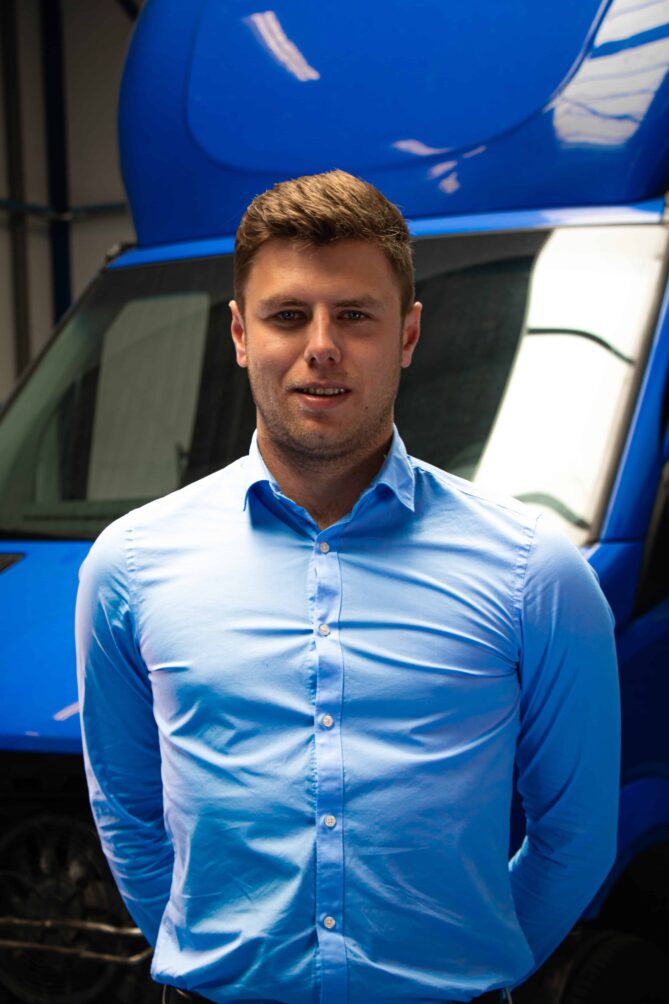
Alex Pap
Emission-free airports
The urgency is high, as airports across Europe are working towards an emission-free cycle. Although the need is greater in some countries than others, Pap has learned. “In Spain, for example, there is enormous pressure. There is an overarching organisation that all airports are affiliated with. They all have to demonstrate in black and white in their tenders that they offer electric equipment.”
In addition to the Netherlands, the company has leads in Spain, Italy and Belgium. The goal is to break into the European market next year. A first step has already been taken: XYZ will soon electrify ten GSE vehicles for an Italian client. Two XYZ engineers will travel to Italy, where they will provide the client’s engineers with several days of training and convert two vehicles. The Italians can then convert the remaining vehicles themselves.
“The advantage of this segment is that airports often manage their equipment themselves. This means they also employ engineers to maintain the equipment. In that sense, it is easy to work together,” says Pap.
Cheaper, emission-free and silent
Electrifying GSE powertrains costs half as much as purchasing new electric GSE vehicles. The lead time is also much shorter, because only the powertrain needs to be converted. “And it is more sustainable, because the existing fleet can simply be put back into use,” Pap adds.
The GSE fleet consists of quite a range of vehicles. In addition to aircraft stair trucks, these include pushback trucks, water trucks for toilet servicing, baggage belt loaders and buses.
“We learned a lot from the electric stair truck we built in 2021. That product has since been further developed. It has an electric powertrain and power source built in. We have now sold a number of them to Schiphol and Italian ground handlers,” says Pap.
The pushback truck was also added to the portfolio: a large, heavy vehicle that pushes aircraft away from the gate when they are ready for departure.
The entire ecosystem needs to move towards electric aviation
While power plants and heavy industry are taking increasingly significant steps towards a CO₂-free sector, aviation is struggling to keep up.
Pushback truck
Pap: “In October 2021, alongside the development work for the van, we started developing a powertrain for a conventional diesel pushback truck. Within a month, we had a working prototype, which we presented at the Inter Airport Show in Munich.”
After the show, XYZ tested the prototype at various airports in the Netherlands, Belgium and Spain under different weather conditions. “That test data was valuable. We quickly saw that the powertrain could be much more efficient, meaning a relatively smaller battery pack would be sufficient. We implemented that in 2022, resulting in a pushback truck with a powertrain that is 95 percent efficient, combined with a fire-safe lithium battery pack.”
It has been a transition, but for Pap, entrepreneurship has only become more enjoyable. “We are constantly building something. That motivates me enormously. When I look back at everything we have done and where we are now, I would never have expected this when we started out as a student team. I’m curious to see what the future still has in store for us.”